In the world of fashion and beauty, trends often emerge from the most unexpected places. Juan Alvear, a celebrity nail artist who began his journey in 2016, has not only redefined the concept of nail art but has also elevated it to the realm of fine art. His creations are a testament to the power of creativity and the limitless potential of self-expression through unconventional means.
Alvear's journey into the world of nails was serendipitous. At the time, he was a student at Cooper Union’s prestigious fine arts program in New York City, honing his skills as a painter and sculptor. His studio was a space of intense focus and dedication, where he spent countless hours perfecting his craft. However, it was a chance encounter with a bottle of Sally Hansen nail polish that would change the course of his artistic trajectory.
"I wasn't even doing those nails in a serious capacity," Alvear recalled with a laugh during a video call. His early manicures were a whimsical blend of "messy" and outlandish designs, featuring large swatches of Barbie pink, abstract doodles in glow-in-the-dark neons, and wiggly lines in deep blue polish that resembled a stormy sea. These creations were not just experiments but also a way for him to keep leftover polish for his sketches and paintings, which he would submit as classwork. Simultaneously, he was building a following on his Instagram page, @byjuanalvear, where his unique designs began to garner attention.
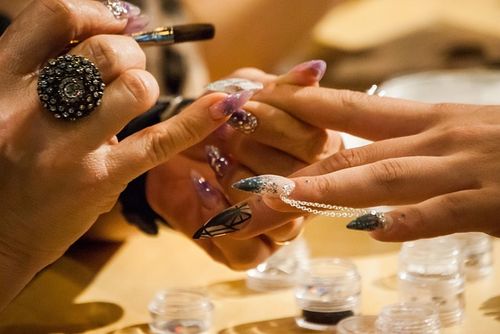
Alvear's designs are nothing short of mind-boggling. They are surreal, eye-catching, and impressive, blending storybook fantasy, dystopian surrealism, and a distinctly Y2K aesthetic. His mixed-media creations defy gravity with their shapes and incorporate surprising materials such as metal spikes, oversized gems, and glossy polishes. Some of his signature designs transform real-world oddities into hyper-realistic nail art, turning an entire hand into a statement piece. As Alvear himself described it, his work is a "twisted fever dream" where everything "exists in excess for no reason."
This artistic exploration quickly gained traction on social media, and Alvear found himself with a cult following that soon eclipsed his traditional paint and sculpture works. Today, he is one of the most sought-after manicurists in the industry, with his work featured in luxury runway shows and on the hands of A-list celebrities like Lil Nas X, Rosalía, and Charli XCX. These celebrities have sported his nails on the red carpet, in magazine spreads, and in high-profile music videos, bringing his unique art form to the forefront of the fashion and beauty world.
The history of nail sculpture is a rich tapestry, with its roots deeply intertwined with the history of fashion and beauty. While it is difficult to pinpoint the exact origin of true nail sculpture, it is widely acknowledged that Black women were pioneers in statement acrylics after their invention in the 1950s. Superstars like Diana Ross and Donna Summer popularized medium-length acrylics in the ‘70s, and American track star Florence Griffith-Joiner became a style icon after breaking two world records at the 1988 Olympics while sporting a six-inch set of red, white, and blue acrylics. Throughout the ‘90s and aughts, statement nails remained a beauty staple for Black women, dominating hip-hop culture thanks to rappers like Missy Elliot and Lil Kim.
However, the more offbeat sculptural sets seemed to emerge around the early aughts in Tokyo’s fashionable Shibuya District. According to Isis Darks, curator of the New York-based exhibition “ACRYLICS: Hidden Sculptural Art” and the accompanying photobook, these early sculptural sets laid the foundation for some of the leading 3D creations. Pioneering nail artist Mei Kawajiri was one of the first to open a “Shibuya style” nail salon in the city during the mid-aughts, where she created 3D sculptures of sweets, strawberries, eggplants, and other playful subject matter, much of which was influenced by her love of “tiny miniature stuff.”
Now based in New York, Kawajiri continues to create sculptures inspired by ordinary, everyday objects — pasta, snails, toys, and remote controls. Like Alvear, Kawajiri has amassed a large online following, which has led to editorial gigs, couture fashion campaigns, and a roster of celebrity clients including Emily Ratajkowski, Jonathan Van Ness, and Kim Kardashian. While Kawajiri prefers more “practical” designs that allow her clients to go about their days relatively unimpeded, Alvear creates ostentatious sculptural creations that are not at all suitable for everyday wear.
Despite their impracticality, Kawajiri noted that Alvear-inspired designs began to pop up all over TikTok and Instagram during the Covid-19 lockdowns. People started doing their own experimental manicures at home, and long nails were less of an issue. In fact, Kawajiri credits Alvear as the artist who made sculptural nail art “go viral” during this time, supporting Darks’ theory about the pandemic’s impact on social media subcultures and culture at large, causing “a major shift in the contribution to nail art, conversation, and the growth of the community.”
As a result, interest in sculptural nails has skyrocketed, with over 34.4 million TikToks hashtagged “#3DNailArt,” celebrities making headlines with their surrealist nails, and the discovery of new artists like Morgan Gilbertson, who went viral last year for her intricate tea set nails. For Alvear, the acclaim still feels a little odd. “I’m thinking that it’s just this weird thing that I kind of stumbled into,” he said, noting that he had long been conditioned by more traditional expectations of what constitutes ‘art’.
Beauty has long been “correlated with self-care and maintenance,” rather than as an interpretation of the body as a canvas. With its primary presentation being on a “human subject,” there has been a “lack of acknowledgement for hairstylists, make-up artists, and nail artists in ‘white cube’ spaces.” One could argue that nails are the least appreciated among the three, as hairstyling has already been the focus of shows at the Musée des Arts Décoratifs in Paris. Meanwhile, makeup artistry has also appeared inside the white cube via in-depth exhibitions examining the link between makeup and politics, and the Metropolitan Museum of Art’s multiple collaborations with the likes of Pat McGrath Labs, Le Labo, and Estée Lauder on limited-edition beauty products inspired by temporary exhibitions and the institution’s permanent collection.
In comparison, nail art displays are often held at independent galleries — DegreeArt.com’s modest show in 2011 or the CND-sponsored exhibit at the Oceanside Museum of Art in 2019 — both of which were focused on painted sets, rather than sculptural pieces. However, some believe this is changing. Recent exhibitions like “ACRYLICS” have sought to put the practice on a pedestal — or a gallery plinth, rather. Alvear has exhibited work, including several standalone fingernail sculptures, in a solo show at the Treize Gallery in Paris, which was said to deftly combine the “often separate realms of fine art, design, and (the) beauty industry.”
"I think the shift is this public acknowledgment and participation in understanding that nail artists aren’t simply doing something ‘low-brow’,” Darks said, noting that “these artists are recreating Basquiat, Van Gogh, and realism portraits” on tiny surfaces. “(It’s) opening the doors and conversations for galleries and curators in the art industry to consider multimedia concepts from these beauty-led mediums,” she said — a sentiment echoed by both Alvear and Kawajiri.
The only real difference, after all, is the substitution of a tube of traditional acrylic paint for a little pot of acrylic sculpting gel. This subtle yet significant shift has not only brought nail art into the limelight but has also challenged the traditional boundaries of what is considered art. Alvear and Kawajiri, along with a new generation of nail artists, are proving that the canvas is not limited to paper or canvas but can be as small and intricate as a fingernail.
As the world of nail art continues to evolve, it is clear that artists like Juan Alvear are leading the charge, pushing the boundaries of creativity and redefining beauty. Their work is not just about making a fashion statement but about expressing a unique vision and telling a story through the medium of nail art. In a world where self-expression is more important than ever, these artists are showing us that there is no limit to the ways in which we can adorn and celebrate our bodies.
The rise of nail sculpture is not just a trend; it is a cultural movement that is challenging our perceptions of art and beauty. It is a celebration of individuality and a testament to the power of creativity. As we look to the future, it is exciting to think about the new heights that nail art will reach and the stories that will be told through this unique and captivating medium. Juan Alvear and his contemporaries are not just creating nail art; they are creating a new language of self-expression that is as powerful as it is beautiful.

By Jessica Lee/Feb 13, 2025
By Grace Cox/Jan 16, 2025

By Emma Thompson/Jan 16, 2025

By David Anderson/Feb 13, 2025

By Victoria Gonzalez/Feb 13, 2025
By Sarah Davis/Jan 16, 2025

By Thomas Roberts/Feb 13, 2025
By George Bailey/Feb 13, 2025

By Rebecca Stewart/Feb 13, 2025

By Emma Thompson/Jan 16, 2025

By Lily Simpson/Feb 13, 2025
By Victoria Gonzalez/Jan 16, 2025
By Victoria Gonzalez/Feb 13, 2025

By Joshua Howard/Feb 13, 2025

By Elizabeth Taylor/Jan 16, 2025

By Michael Brown/Jan 16, 2025

By David Anderson/Jan 16, 2025

By Christopher Harris/Jan 16, 2025
By David Anderson/Feb 13, 2025
By Elizabeth Taylor/Jan 16, 2025