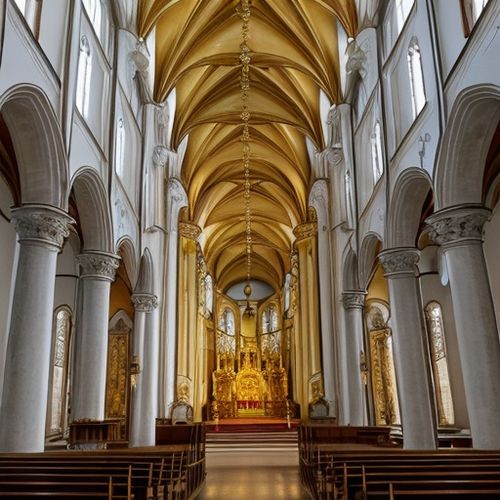
In the hallowed halls of Vilnius Cathedral, a story of lost and found has unfolded, revealing a treasure trove that has lain dormant for decades. The recent discovery of historical artifacts, once concealed within the cathedral's crypts, has not only unearthed physical relics but also rekindled the memories of a bygone era, connecting the present with the grandeur of medieval Europe.
The cache, which had been hidden since the outbreak of World War II in 1939, according to a press release from the Go Vilnius tourism promotion agency, is a testament to the rich history and cultural heritage of Lithuania. Among the items are burial crowns and insignia that once belonged to the rulers of medieval Europe, including Alexander Jagiellon, or Aleksandras Jogailaitis, who reigned as King of Poland and Grand Duke of Lithuania from 1461 to 1506. His crown, a symbol of power and sovereignty, now stands as a silent witness to the passage of time.
Equally significant are the artifacts associated with Elizabeth of Austria, or Elžbieta Habsburgaitė, who lived from 1436 to 1505. Her crown, chain, medallion, ring, and coffin plaque are not merely objects of adornment but are imbued with the history of a time when the Habsburgs were a dominant force in European politics. These items, like the others, were not worn in life but were created posthumously to honor the deceased and to form part of the burial tomb, reflecting the burial and honoring practices of the era.
Barbara Radziwiłł, or Barbora Radvilaitė, is another historical figure whose memory is preserved through the recovered artifacts. Married to Sigismund II Augustus, or Žygimantas Augustas, she was a significant figure in the history of Poland and Lithuania. Her crown, scepter, orb, rings, chain, and coffin plaques are a testament to her status and the opulence of the court in which she lived. Her death in 1551 marked the end of an era, but the discovery of her burial insignia has brought her story back to life.
Vilnius Archbishop Gintaras Grušas, in a statement by the Vilnius Archdiocese, described the discovered burial insignia as "priceless historical treasures, symbols of the long tradition of Lithuanian statehood, signs of Vilnius as the capital city, and magnificent works of goldsmithing and jewelry." These artifacts are not just material possessions; they are the threads that weave the tapestry of Lithuania's past, connecting the present generation to the legacy of their ancestors.
The significance of this discovery extends beyond the borders of Lithuania. It is a reminder of the shared European identity and the deep roots that bind the nations of the continent together. Rita Pauliukevičiūtė, director of the Vilnius Church Heritage Museum, emphasized this point, stating that "these symbols are important both for the State and for each of us, as signs of European identity, as a reclaimed identity of the old State, as a sign of the strength of our roots."
The journey of these artifacts is as fascinating as the stories they tell. First discovered in 1931 during the cleaning of the cathedral following a spring flood, they were revealed in a crypt containing the remains of the rulers. They were put on display until the outbreak of World War II in 1939, when they were hidden away for safekeeping. For decades, they remained a secret, eluding the efforts of several fruitless searches. It was not until September 2024, when researchers turned their attention to the crypts once more, that the endoscopic camera revealed the location of the hidden treasures. Wrapped in newspapers dated September 1939, the artifacts were finally recovered in December, a poignant reminder of the world that was on the brink of war.
The future of these artifacts is one of preservation and presentation. According to the archdiocese, they will be examined, restored, and eventually presented to the public. This process is not just about the physical restoration of the items but also about the revival of the stories they carry. Each piece, every detail, holds a clue to the past, and as they are restored, so too will the memories of the monarchs and the era they represent.
The discovery of these treasures in Vilnius Cathedral is more than just a historical find; it is a bridge between the past and the present. It is a reminder of the resilience of history and the enduring power of cultural heritage. As these artifacts are brought back into the light, they will serve as a beacon, guiding future generations to explore, understand, and appreciate the rich tapestry of European history. The crypts of Vilnius Cathedral have given up their secrets, and in doing so, have gifted the world with a renewed sense of connection to the past and a deeper understanding of the roots that bind us all.

By Jessica Lee/Feb 13, 2025

By Grace Cox/Jan 16, 2025

By Emma Thompson/Jan 16, 2025

By David Anderson/Feb 13, 2025

By Victoria Gonzalez/Feb 13, 2025

By Sarah Davis/Jan 16, 2025
By Thomas Roberts/Feb 13, 2025

By George Bailey/Feb 13, 2025

By Rebecca Stewart/Feb 13, 2025

By Emma Thompson/Jan 16, 2025
By Lily Simpson/Feb 13, 2025

By Victoria Gonzalez/Jan 16, 2025

By Victoria Gonzalez/Feb 13, 2025

By Joshua Howard/Feb 13, 2025
By Elizabeth Taylor/Jan 16, 2025

By Michael Brown/Jan 16, 2025
By David Anderson/Jan 16, 2025

By Christopher Harris/Jan 16, 2025

By David Anderson/Feb 13, 2025

By Elizabeth Taylor/Jan 16, 2025